The family multi-storey apartment building in Athens
Tsellos Konstantinos
Built Environment, Housing, Social Structure

2025 | Jun
At a first glance into the city of Athens from one of its hills, the sea of thousands of multi-storey apartment buildings [1] (polykatoikia) forms an evidently homogeneous landscape. The constant repetition of the building type of the apartment building as an image and morphology seemingly refers to some kind of equality between the dwellings, and therefore between the inhabitants, misleadingly suggesting the absence of particular social, economic and cultural contrasts. However, focusing on smaller scales and researching the history of the post-war reconstruction of Athens can reverse the above observation. The single building type of the apartment building is an aggregate of multiple variants (Tsiambaos, 2022), while each modification has been created in dissimilar and unequal ways.
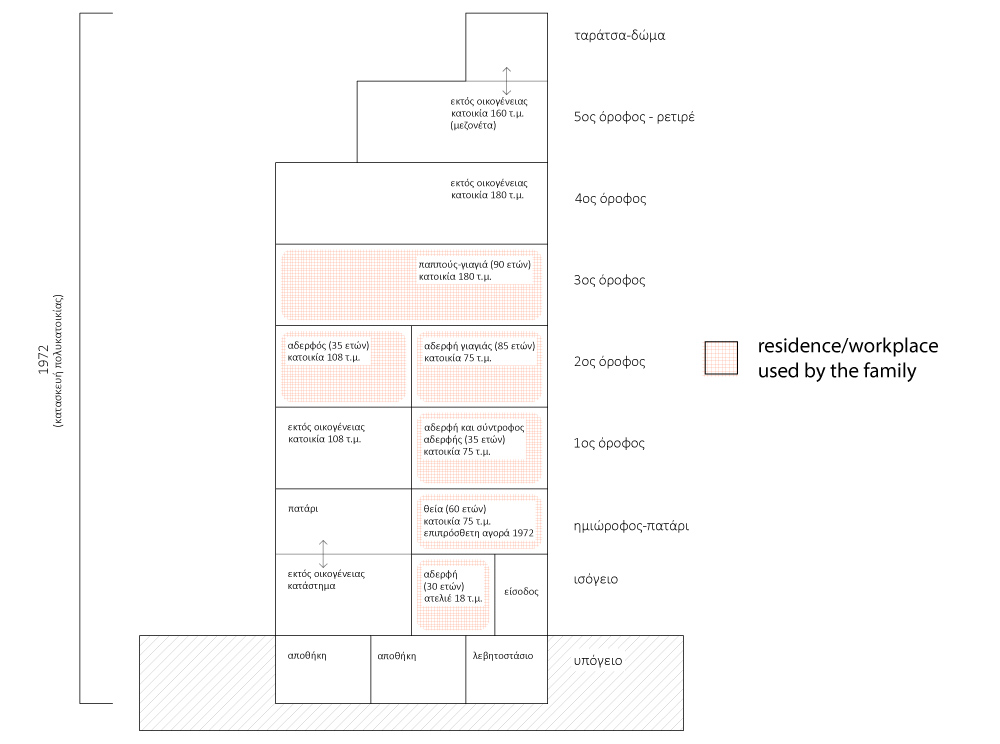
The family multi-storey apartment building is an unsophisticated, unscientific and almost oral term. What this paper attemps to define, describe and highlight, is the family multi-storey apartment building as a piece of these variants and as a distinct product of the prevailing post-war housing systems. In addition to the literature review, family apartment buildings in Athens were studied (interviews were conducted with current and former residents and diagrammatic drawings were produced), while maps were created following the analysis of quantitative and statistical data from the building censuses of ELSTAT (2011) and the Ministry of Environment and Energy.
Historical context
The urban map of Greece changed significantly after the end of World War II and the Civil War. The intense migration from the countryside to the large urban centers, especially Athens, resulted in the multiplication of the population of the capital and the transformation of its urban fabric.
The fact, however, that in post-war Athens there were neither many jobs –since no major industry had developed– nor adequate welfare services were offered, led internal migrants to seek permanent housing as the only element that would grant them a minimum condition of security for their new life in the capital (Maloutas, 2018: 80). The path to obtaining this housing was through private housing construction. The two housing systems that were widely applied for private reconstruction in post-war Athens and addressed this urgent housing need were self-promotion and the [2] system.
Self-promotion was the housing system that developed predominantly in the first post-war decades of the 1950s and 1960s. According to it, the land owner decides, manages and finances the whole building process for the housing of himself and his family (Maloutas, 2018: 28; Mantouvalou, 1996: 56). Spatially, it developed mainly in the suburbs of Athens and especially on its western side. Given that these areas were agricultural land that was not included in the city plan, building in them was often arbitrary.
Morphologically, the popular dwelling of self-promotion, often the product of self-construction by relatives and friends, was a single-storey dwelling which initially consisted of a single-room core. Over time, this core evolved, was extended (addition) or even replaced by more permanent structures. In addition to the horizontal extensions, the core was also expanded vertically through the so-called ‘panosikoma’ (adding extra floors) and gradually transformed into a small apartment building. This small, low-rise apartment building constitutes the basic core of the so-called ‘family multi-storey apartment building’ (family polykatoikia), which will be analysed in detail below.
Regarding the ‘antiparochi’ housing system, it dominated during the 1960s and 1970s, shaping the image of Greece’s major cities, especially Athens. The result of this system was the multi-storey apartment building (‘polykatoikia’). Spatially, the ‘antiparochi’ system developed primarily within the municipality of Athens, then expanded to neighbouring eastern and southern municipalities, and later, through the process of suburbanization, spread across the wider metropolitan area of Athens (Maloutas, 2000: 28). According to Woditsch and Kammerbauer (2018: 85-111), the antiparochi apartment building in Athens can be analyzed through nine fundamental characteristics: column grid, staircase, floor heights, the ground-floor arcade ‘stoa’, balconies, setbacks, flat roof, vertical socioeconomic hierarchy, and the mix of public and private functions.
Greek family and housing
In Greece, the roots of the modern Mediterranean family lie in its recent rural past, where the relationship with the land, production and housing was a family affair. Similarly, in the conditions of post-war urbanization, access to housing continued to be a family affair, which was self-financed by family resources, given both the minimal contribution of the state to the production of housing and the absence of housing credit until the 1990s (Economou, 1987; Maloutas, 2018). In the new metropolitan environment, family networks were restructured, taking on multiple roles such as securing housing and employment for family members, childcare and elderly care. These relationships and mutual aid practices required ensuring spatial proximity between members of the extended family [3] (Allen et al., 2004). Thus, for many families, the choice was made to live in the same neighbourhood or even in the same apartment building, in separate apartments. Over time, numerous family apartment buildings were constructed, serving as the clearest spatial representation of an extended family living in the capital.
Family multi-storey apartment building – definition
It is clear that the term ‘family multi-storey apartment building’ is not an established scientific term but rather a colloquial expression. It is also possible that the use of this term may create confusion regarding what the adjective ‘family’ specifies in relation to the noun ‘apartment building’/‘polykatoikia’. Nevertheless, the spatial model that attempts to describe a family apartment building refers to an apartment building where members of the same family reside in its different apartments.
A more comprehensive definition of the family multi-storey apartment building is based on four key points: a) that a member or members of the same family owned the original plot of land on which the apartment building was constructed, b) that the apartments in this building are owned by family members and are owner-occupied, c) that the majority of the apartments belong to family members, allowing the extended family to have ‘control’ over the entire building, d) that the new building meets the basic characteristics of ‘polykatoikia’, meaning it is a multi-storey building (ground floor + 2 floors and above) with self-contained apartments (at least three separate dwellings).
Based on these four points, some important secondary conclusions and observations can also be drawn. Firstly, the primary goal of constructing a family apartment building is to provide housing for its members. The family apartment building is created primarily to address the housing needs of the family and secondarily (and only if there is a surplus of space) to make profit from the utilization of the additional space built, either by renting or selling it. Therefore, the significantly increased value of the constructed space compared to the original plot or the initial detached house does not constitute an investment move, but is utilized for the housing needs of the family members. This observation structurally differentiates the family apartment building from an apartment building constructed purely as an investment, with the typical antiparochi apartment building positioned somewhere in between. This differentiation is evident in the mode of production, the spatial quality of the apartments, and even the composition of the households within them.
A second observation regarding the definition of the family apartment building relates to the aspect of residency. As noted, an apartment building is regarded as a family apartment building not only when it is owned by family members but also when it is inhabited by them. Therefore, the fact that a building was initially constructed as a family apartment building does not automatically mean that it will retain this characterisation over time. An apartment building becomes, remains or is converted into a family apartment building as long as family members reside in its apartments. If most family members move out, even if they still own the apartments, the building ceases to be considered a family apartment building.
The above observation relates to the sense of family cohesion. It refers to the development of familiarity among residents-relatives within the spatial shell of the apartment building, which is perhaps one of the most defining characteristics of a family apartment building. For this sense of family cohesion to prevail, daily communication is required; everyday –even incidental– interactions and encounters, mutual assistance, shared practices and arrangements among family members reinforce this feeling.
Family multi-storey apartment building and housing systems
In terms of construction methods, the family multi-storey apartment building –despite the variations it presents– follows the dominant housing systems of self-promotion and the ‘antiparochi’ system, which were implemented in Athens during the post-war decades.
Family multi-storey apartment building through self-promotion
Primarily, the family multi-storey apartment building is constructed through the custom-built self-promotion system (involving a contractor) and secondarily through self-construction. In terms of form, the resulting family building is a small-scale apartment building. It is a low-rise building (usually 2-storey [4] or 3-storey apartment building), with limited building coverage [5] (typically around 100 square meters) and few apartments (usually 3-5 apartments). For this reason, floor-through apartments are a common feature in family apartment buildings. In practice, for each new family member who became independent and wanted to start their own family, an additional floor was added. Apart from its size, the family apartment building through self-promotion also differs in other morphological aspects compared to the typical multi-storey apartment building of Athens. For example, features like the top floors’ setbacks or the ground-floor arcade are absent, there is no emphasis on common spaces, such as the entrance, and the elevator is often missing.
The construction method of the self-promotion family apartment building differed from that of a typical apartment building through the antiparochi system. Given that the construction cost of even such a small apartment building was relatively high for the working and lower-middle classes, the family apartment building was usually not constructed all at once but in phases. The different phases involved both the construction of the load-bearing structure –specifically the concrete framework– and the finishing works of each apartment (such as masonry, fillings, interior fittings, etc.). There are cases where the ground floor of the apartment building was initially constructed, and later, with the well-known method of ‘panosikoma’ (adding extra floors) and ‘anamones’ (rebars protruding from the rooftop slab, intended to support one or more additional floors in the future), floors were added. In other cases, the concrete framework for all building was poured at once, but the final completion of all the floors extended over the years. The final phase of the expansion of the family apartment building usually involves the rooftop structure (‘doma’). The small room, which was initially constructed either as the end of the staircase or as the top of an elevator shaft, is horizontally extended, often illegally, onto the shared rooftop terrace, transforming into a small studio or an enlarged storage room for family members. The widespread arbitrariness of expanding the rooftop structure onto the communal terrace seems like an obvious move in the case of the family apartment building, as the spatial needs are high and there are no objections or controls from other co-owners.
The financing of family apartment buildings also occurred in phases, parallel to the progress of construction work, as the initial capital usually did not cover the complete construction. To reduce costs, family members sometimes personally participated in the construction process. Apart from a phased completion, there were also cases of family apartment buildings that were fully constructed from the beginning. More financially robust social strata (professionals with ties to the construction sector, such as contractors, families who sold assets in the provinces, or families with substantial savings) managed to immediately build an apartment building for self-housing.
Figure 1: Family apartment building through self-promotion in Vyronas (construction phases, uses and size of apartments, relationship between residents-relatives).

Note: The determination of the family relationship is based on the interviewee, approximately 25 years old.
Figure 2: Family apartment building through self-promotion in Ilioupoli (construction phases, uses and size of apartments, relationship between residents-relatives).

Note: The determination of the family relationship is based on the interviewee (no longer residing in the family apartment building), approximately 30 years old.
Figure 3: Family apartment building through self-promotion in Haidari (construction phases, uses and size of apartments, relationship between residents-relatives).

Note: The determination of the family relationship is based on the interviewee, approximately 30 years old.
Figure 4: Family apartment building through self-promotion in Lycabettus (construction phases, uses and size of apartments, relationship between residents-relatives).

Note: The determination of the family relationship is based on the interviewee (no longer residing in the family apartment building), approximately 30 years old.
Family multi-storey apartment building through antiparochi
The second construction method for the family apartment building is through the antiparochi system. The main problem in converting an apartment building into a family apartment building through antiparochi is related to the increased cost, but also to the percentages that the landowner and the contractor will receive on the final product. Given that the contractor usually receives the highest percentages, the question is how the landowner manages to secure the majority of the apartments in the apartment building for his family. This can be achieved either by the landowner purchasing additional apartments from the contractor from the outset, or by gradually acquiring additional apartments over time. In other cases, the contractor himself may choose not to sell the apartments he owns in order to house his family. Things are simpler when the collaboration between the landowner and the contractor is a family affair.
In the case of family apartment buildings through antiparochi, we are not referring to purely family-owned buildings as is usually the case with self-promotion. In antiparochi apartment buildings, family members own the majority of the apartments, in relation to third-party residents living in the same building. In terms of form and size, the family apartment building through antiparochi typically resembles a conventional multi-storey apartment building (3 to 6 floors). However, due to the small plot size or low building coefficient, it has relatively few apartments (usually up to 10 apartments).
Figure 5: Family apartment building through antiparochi in Ilisia (construction phases, uses and size of apartments, relationship between residents-relatives).

Note 01: The determination of the family relationship is based on the interviewee (no longer residing in the family apartment building), approximately 25 years old.
Note 02: It is indicative that the mezzanine apartment was purchased by the family from the contractor in addition to the square meters they would receive through the antiparochi system
Figure 6: Family apartment building through antiparochi in Petroupoli (construction phases, uses and size of apartments, relationship between residents-relatives).

Note 01: The determination of the family relationship is based on the interviewee (no longer residing in the family apartment building), approximately 30 years old.
Note 02: It is indicative that the apartments on both the 2nd and 3rd floors were purchased later by the family.
The family multi-storey apartment building through self-promotion in Athens; spatial and temporal dimensions
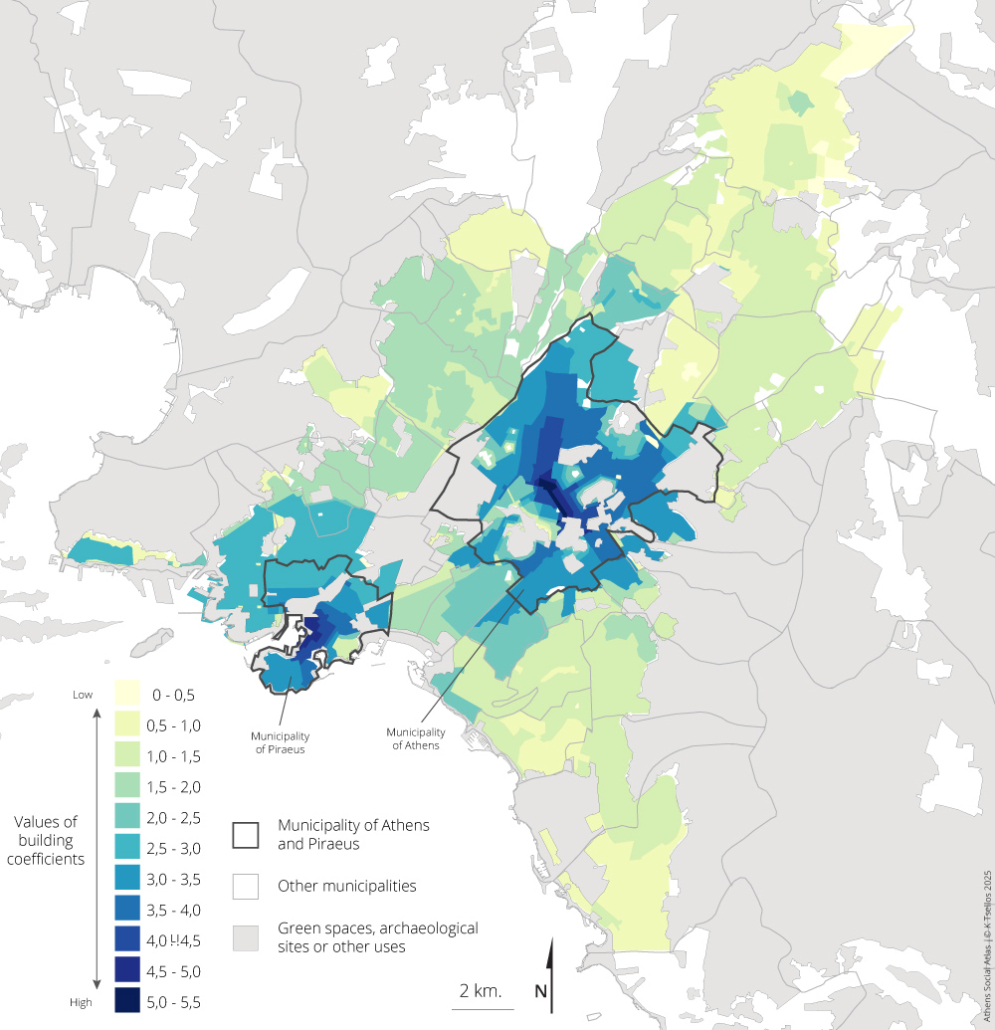
Taking into account the morphological characteristics of the family apartment building through self-promotion, an attempt has been made to identify the areas and periods in which it is most commonly found. Using data from the 2011 building census by ELSTAT, as well as information from the Ministry of Environment and Energy, maps 1-3 have been produced for the metropolitan area [6]of Athens; map 1 illustrates the values of the building coefficients, map 2 shows the percentage (per municipality) of 2-storey and 3-storey apartment buildings (out of the total number of buildings) and map 3 the percentage (per municipality) of buildings with 3 to 5 apartments (out of the total number of buildings). Combined, these maps offer an initial understanding of the areas and municipalities where family apartment buildings are mainly concentrated.
According to map 1, the areas with the highest building coefficients (from 3.5 and above) are located in the municipalities of Athens and Piraeus, but also in the neighbouring municipalities, with coefficients from 2 to 3.5. Low to medium building coefficients (from 1 to 2) correspond to peripheral areas, with a focus on the western suburbs (Agia Varvara, Chaidari, Ilion, Peristeri, Petroupoli, Agioi Anargyroi, Nea Filadelfeia-Chalkidona), where small-sized and low-rise family apartment buildings are concentrated. Similar values can also be found in the northern suburbs (Metamorfosi, Irakleio, Marousi, Chalandri, Agia Paraskevi, and Papagou-Holargos), as well as in the southern (Moschato) and southeastern areas of Athens (Ymittos, Agios Dimitrios, Ilioupoli, Elliniko-Argyroupoli). Finally, the lowest building coefficients (up to 1) are found in the most sparsely populated suburbs of Athens with scattered single and doublex houses.

Map 1: Values of building coefficients in the metropolitan area of Athens
Own elaboration based on data from the Ministry of Environment and Energy
Maps 2 and 3 identify (at the municipal level) the presence of 2-storey and 3-storey buildings, as well as residential buildings with 3 to 5 apartments. Map 2 shows that the highest concentration of 2 and 3-storey buildings is located in the western part of the city –particularly in the municipalities of Aigaleo, Peristeri, and Petroupoli– as well as in the southeastern part, mainly in the municipalities of Agios Dimitrios, Ilioupoli, Elliniko-Argyroupoli, and Glyfada, and also in the municipality of Galatsi. This picture seems to be confirmed –with some variations– in regards to the spatial concentration of buildings with 3 to 5 apartments (map 3).

Map 2: Percentage of 2-storey and 3-storey apartment buildings (out of all buildings) per municipality
Own elaboration based on data from the 2011 building census by ELSTAT

Map 3: Percentage of buildings with 3 to 5 appartments (out of all buildings) per municipality
Own elaboration based on data from the 2011 building census by ELSTAT
A more detailed analysis at smaller spatial scales and/or a correlation between building size and plot area per region would be needed to draw more reliable conclusions. These three maps serve as indications that buildings of these dimensions –typically corresponding to self-promotion family apartment buildings– are mainly located in municipalities on the periphery of the Municipality of Athens with a middle-class social profile (in the southeast) or in municipalities with a working-class past and significant endogenous social mobility in recent decades (in the west).
Family apartment buildings through self-promotion were mainly constructed from the early 1970s, essentially marking a second phase of the self-promotion system. This phase succeeded the first self-promotion phase (1950s and 1960s), which was characterized by single-storey houses and horizontal extensions. In the second phase, family apartment buildings were gradually built with vertical additions of storeys.
The construction of family apartment buildings through self-promotion occurred later than that of typical apartment buildings through antiparochi. This is primarily because they represent the second phase of the self-promotion system, which was closely linked to the intergenerational social mobility of the working-class strata that self-housed in the western part of the city. Moreover, family apartment buildings are located in the city’s periphery, where low building coefficients and small plot sizes made the construction through antiparochi unprofitable for both landowners and contractors.
Maps 4A, 4B, 4C, and 4D illustrate that the highest rates of 2-storey apartment buildings construction are primarily found in the decade 1971-1980 and, secondarily, in the decade 1981-1990.

Maps 4A, B, C & D: Rates of 2-storey apartment buildings construction by decade.
Own elaboration based on data from the 2011 building census by ELSTAT
Socioeconomic characteristics, uses, residential status
Focusing on the interior characteristics of family apartment building through self-promotion shows that it is a largely homogeneous residential environment. More specifically, it lacks phenomena commonly observed in Athens’ multi-storey apartment buildings, such as vertical social segregation, where households are stratified by class and sometimes by ethnicity across different floors. This type of building is predominantly “Greek”, with no presence of migrants, where the residents across its floors do not exhibit significant socioeconomic differences. This homogeneity is reinforced by the persistence of family cohabitation and spatial proximity, along with practices of mutual aid and support, fostering social convergence among households and reducing the risk of marginalization for their members.
The second aspect of homogeneity relates to the uses of the building. In the case of family apartment buildings, residential use predominates. Since these buildings were primarily constructed to meet the housing needs of family members and have limited square footage, there is usually no surplus space for other uses, as is often the case in larger or more centrally located apartment buildings in Athens. For the same reasons, vacant apartments are virtually absent in family apartment buildings; the need to meet growing housing demands and the distinct family-centered nature of ownership ensure the immediate reuse of any available spaces.
This distinct family-centered nature of ownership lies in the fact that, regardless of the formal ownership of the apartments, there is a prevailing sense of collective ownership. This allows for flexibility in moving between apartments within the building. Internal housing mobility significantly affects residential status, as the scheme of rent-free accommodation is widely applied, either formally or informally. Alongside the common legal actions primarily aimed at reducing a family’s tax burden (e.g. transfers of full or bare ownership, parental grants, etc.), spatial rearrangements among family members also take place, regardless of formal ownership titles. Consequently, owner-occupation and rent-free accommodation completely dominate as residential status in family apartment buildings. The following diagrammatic plans (figures 07-12) depict the residential status and the relationship (whether familial or not) between resident and owner for the apartments in the family apartment buildings that were studied.
Figure 7: Diagrammatic plan of residential status and kinship relations in family apartment building through self-promotion in Vyronas

Figure 8: Diagrammatic plan of residential status and kinship relations in family apartment building through self-promotion in Ilioupoli

Figure 9: Diagrammatic plan of residential status and kinship relations in family apartment building through self-promotion in Haidari

Figure 10: Diagramatic plan of residential status and kinship relations in family apartment building through self-promotion in Lycabettus
Figure 11: Diagrammatic plan of residential status and kinship relations in family apartment building through antiparochi in Petroupoli

Figure 12: Diagrammatic plan of residential status and kinship relations in family apartment building through antiparochi in Ilissia

Appropriation of space and family practices
The intimate relationships between the residents-relatives, along with the sense that the entire building belongs to the family, give the common spaces a different character. Thus, all these spaces (such as the shared rooftop, apartment entrance, front yards, pilotis, backyard, etc.), which in typical apartment buildings are often neglected and remain empty and unused, are transformed, in family apartment buildings, into vital and functional spaces for family members. Starting from the outdoor spaces on the ground floor, the connection with the land and the broader public space is more pronounced. The appropriation of the front yard, pilotis, or backyard is often combined with plant care, children’s play, or gatherings of friends and relatives, referring to the conditions of a rural community. The building’s entrance, the staircase and the common corridors also differ from the clean, functional, empty spaces of a typical apartment building. Given that in family apartment buildings there is often a lack of space, these common spaces serve as extensions of the apartments by functioning as storage spaces. Finally, the rooftop of the family apartment building often acts as a shared active outdoor area, taking on various uses such as for play, rest, or family gatherings.
Conclusion
In post-war Athens, the family multi-storey apartment building through self-promotion appears to function as a mechanism for integrating and assimilating working-class households into the broader lower-middle-class strata. It bridges –materially, symbolically, and morphologically– the gap between two worlds with distinct characteristics. On one side lies the rural, pre-modern, popular, and impoverished world, which, in the post-war era, finds housing in inadequate, illegal, and self-constructed single-storey dwellings among relatives and fellow villagers, reproducing the “closed” conditions of village life in the suburbs of Athens. On the other side, wealthier social strata reside in modern apartments with contemporary amenities in the multi-storey apartment buildings constructed through the antiparochi system. Thus, the small 2-storey or 3-storey family apartment building forms a bridge between these two worlds. It gradually meets the growing housing needs of working-class families, improves infrastructure and housing standards, and softens the morphological differences compared to the multi-storey apartment buildings of the capital. At the same time, however, it maintains and reproduces the framework of cohabitation and communal living of the extended family as a closed system, with practices of mutual aid and control that spatial proximity facilitates and often enforces.
The future and the prospects for maintaining the condition of the family apartment building depend on a variety of factors. Certainly, the advantages of family cohabitation, collective living, mutual aid practices, and support for the most vulnerable members are strong arguments in favor of the family apartment building, especially during periods of economic and housing crises. However, equally significant disadvantages, such as increased control and reduced opportunities for individual autonomy, seem to counterbalance these positive aspects. The mutual support among family members is accompanied by a framework of mutual interests and obligations, within which hierarchical relationships based on gender, age, or degree of kinship tend to dominate.
In conclusion, the family multi-storey apartment building represents a significant element of post-war housing systems and the Greek ‘polykatoikia’. It is a phenomenon shaped by multiple factors, most notably by the dominant position of the Greek family within the social structure, particularly in the housing sector. Therefore, the potential preservation or reproduction of the family apartment building will depend on many diverse factors, with the most crucial being the future role of the Southern European and Greek family and the possible transformations it may undergo.
[1] The term ‘multi-storey apartment building’ refers to the Greek ‘polykatoikia’.
[2] According to the ‘antiparochi’ system, a landowner could transfer their plot to a contractor in order to build a multi-storey apartment building. In return, the landowner would receive a predetermined number of apartments in the completed building instead of monetary payment.
[3] An extended family is a family that extends beyond the nuclear family and may include other relatives such as grandparents, aunts, uncles, nieces, nephews, etc.
[4] When referring to a 2-storey apartment building, it means a building with a ground floor plus two additional floors. Similarly, a 3-storey apartment building refers to a building with a ground floor plus three additional floors, and so on.
[5] Building coverage is the horizontal projection of the building on the ground.
[6] The maps specifically refer to 40 municipalities of Athens (northern, southern, central, and western sectors) and Piraeus, as defined by the Kallikratis reform.
Entry citation
Tsellos, K. (2025), The family multi-storey apartment building in Athens, in Maloutas T., Spyrellis S. (eds) Athens Social Atlas. Digital compendium of texts and visual material. URL: https://www.athenssocialatlas.gr/en/article/the-family-multi-storey-apartment-building-in-athens/ , DOI: XXX
Atlas citation
Maloutas T., Spyrellis S. (eds) (2015) Athens Social Atlas. Digital compendium of texts and visual material. URL: https://www.athenssocialatlas.gr/en/ , DOI: 10.17902/20971.9
References
- Θεοχαροπούλου, Ι. (2022), Χτίστες, νοικοκυρές και η οικοδόμηση της σύγχρονης Αθήνας, Αθήνα, Ίδρυμα Ωνάση.
- Μαλούτας, Θ. (επιμ.) (2000), Κοινωνικός και Οικονομικός Άτλας της Ελλάδας: Τόμος 1: Οι Πόλεις, Αθήνα-Βόλος, ΕΚΚΕ-Πανεπιστημιακές Εκδόσεις Θεσσαλίας.
- Μαλούτας, Θ. (2018), Η κοινωνική γεωγραφία της Αθήνας, Αθήνα, Αλεξάνδρεια.
- Maloutas, T. & Karadimitriou, N. (2001), Vertical social differentiation in Athens. Alternative or complement to urban segregation?, International Journal of Urban and Regional Research, 25 (4): 699-716.
- Μαντουβάλου, Μ. (1996), Αστική γαιοπρόσοδος, τιμές γης και διαδικασίες ανάπτυξης του αστικού χώρου ΙΙ: προβληματική για την ανάλυση του χώρου στην Ελλάδα, Επιθεώρηση Κοινωνικών Ερευνών, έκδοση ΕΚΚΕ, 89: 53-80.
- Οικονόμου, Δ. (1987), Η στεγαστική πολιτική στη μεταπολεμική Ελλάδα: βασικές ερμηνευτικές υποθέσεις, πιστοδότηση της στέγης και πολιτική ενοικίων, Επιθεώρηση Κοινωνικών Ερευνών, έκδοση ΕΚΚΕ, 64: 56-129.
- Τσιαμπάος, Κ. (2022, 09/13), Μια συνομιλία για τη μορφή και τη νοοτροπία της μεταπολεμικής πολυκατοικίας, Athens Voice
- Woditsch, R. & Kammerbauer, M. (2018), ‘Approaching the Polykatoikia’, στο Woditsch, R. (επιμ.) (2018), The public private house. Modern Athens and its polykatoikia, Ζυρίχη, Park Books, σ. 77-111.